
前言:此部分文章并非系统性的教学文章,网络上已经很多非常优秀的教学课程,顶尖且免费。比如,哔哩哔哩上李沐大神的《动手学深度学习v2》,Andrej Karpathy 在 YouTube 上教程,以及 Standford CS224N 课程。 这里主要记录作者的一些理解,有意思的知识点,或者豁然开朗的乐趣,希望你也能喜欢!
Tokenizer 没有很好的中文词汇来表达其含义,因此不做翻译,包括 token、tokenization。
如果你有代码层面使用开源的 LLM Pretrained 模型的经验,或者看过 HuggingFace 上各个模型使用的示例代码,那么应该不会对以下代码感到陌生。
起手第一行便是初始化 tokenizer,其后才是创建 model。
tokenizer = AutoTokenizer.from_pretrained("THUDM/chatglm3-6b", trust_remote_code=True)
model = AutoModel.from_pretrained("THUDM/chatglm3-6b", trust_remote_code=True).half().cuda()
看起来,tokenizer 和 model 之前相互独立。其实不然,tokenizer 和 model 之前是强绑定的,某个模型依赖一个特定的 tokenizer,而一个 tokenizer,比如 llama 系列的 tokenizer,往往可以支持同一个系列的衍生模型。
在系统层面,它们就完全属于两个不同的模块了。 Tokenizer 的历史要远早于基于 Transformer(2017 年)的大语言模型。Tokenizer 与所有机器学习算法类似,都需要训练。但与大语言模型的训练出来的结果不同,Tokenizer 与传统机器学习算法一样,对于相同的输入,输出是确定的;而大语言模型的惊人之处就在于,它更接近于人类,一个泛化的问题,不同的人,或者同个人在不同时间的回答会有区别。
接下来,我们会从1)什么是 Tokenizer?2)Tokenizer 相关算法。3)如何训练 Tokenizer?4)Tokenizer 的使用,这几方面来介绍 Tokenizer。
1. 什么是 Tokenizer? #
狭义的大语言模型(除去图片、音、视频的多模态部分)是自然语言处理(NLP)的一种模型算法,如今也可以说是唯一事实模型标准。要做自然语言处理,无论是翻译,还是总结、补全、chat 都需要首先理解输入。
自然语言是人创造的,自然,而且也只能借鉴人是如何理解自然语言的。我们学习语言的时候,先学字(英文字母),再学词,最后成句变文章,当然无需纠结这个顺序是否严格。
字相对较少,特别是印欧语系,英文就 26 个字母(todo…)。而汉字字库将近十万,书面资料的 99% 的内容可被 3000 常用字覆盖。
词的数量就远不止字数了,收录在《牛津英语词典》中有 17 万余单词,派生词也有 9500,中文词汇更是达 40 多万,更不用提短语、句子了。
使用字还是词作为标准,各有优缺点。字、词少了,比较难学到“知识”。如果多了,模型参数膨胀,且对新词学习不利。
2. Tokenizer 算法 #
特别是英文,存在大量派生词,因此就有了 subword 的 tokenize 方式。
>>> tokenizer.tokenizer.sp_model.encode_as_pieces('Sentence Piece is an unsupervised text tokenizer and detokenizer mainly for Neural Network-based text generation systems where the vocabulary size is predetermined prior to the neural model training.')
# Chatglm3: AutoTokenizer.from_pretrained("THUDM/chatglm3-6b", trust_remote_code=True)
['▁Sent', 'ence', '▁P', 'iece', '▁is', '▁an', '▁uns', 'up', 'erv', 'ised', '▁text', '▁token', 'izer', '▁and', '▁det', 'oken', 'izer', '▁mainly', '▁for', '▁Ne', 'ural', '▁Network', '-', 'based', '▁text', '▁generation', '▁systems', '▁where', '▁the', '▁vocabulary', '▁size', '▁is', '▁pred', 'etermined', '▁prior', '▁to', '▁the', '▁neural', '▁model', '▁training', '.']
# Llama2: AutoTokenizer.from_pretrained("TheBloke/Llama-2-7b-Chat-GPTQ", use_fast=True)
['<s>', 'Sent', 'ence', 'Pie', 'ce', 'is', 'an', 'un', 'super', 'vised', 'text', 'token', 'izer', 'and', 'det', 'oken', 'izer', 'mainly', 'for', 'Ne', 'ural', 'Network', '-', 'based', 'text', 'generation', 'systems', 'where', 'the', 'voc', 'ab', 'ul', 'ary', 'size', 'is', 'pred', 'et', 'erm', 'ined', 'prior', 'to', 'the', 'neural', 'model', 'training', '.']
目前有三种主流的 Subword 算法,分别是 BPE 、Wordpiece 和 Unigram。
2.1. BPE #
Llama、GPT2 等模型使用 BPE 作为 Tokenizer 的算法。
以英文为例,绝大部分英文文字内容可用 ASCII 表中的 95 个可显字符表示。当然 BPE 算法处理的不仅仅是英文,处理的文本内容使用的是 Unicode-8 编码,后续会进一步展开。
1)BPE 算法首先会将所有英文字母、标点、空格等独立计算它们出现的频率。空格比较特殊,暂且不表。
2)使用贪心算法,每次取出现频率最高的相邻两个 subwords,组成新的 subword,同时更新涉及到的 3 个 subwords 的出现频率。
3)重复步骤二,直到满足自定义的 subword 个数为止。
此算法比较直观,使用了贪心算法,效率也很高。
def bpe_encode(text, vocab, vocab_scores):
    tokens = []

    # First encode every individual character in the input text
    for pos, char in enumerate(text):
        string = char
        id = str_lookup(string, vocab)
        if id == -1:
            print(f"not a good prompt at pos {pos}")
            sys.exit(1)
        tokens.append(id)

    # Merge the best consecutive pair each iteration, according to the scores in vocab_scores
    while True:
        best_score = -1e10
        best_id = -1
        best_idx = -1

        for i in range(len(tokens) - 1):
            # Check if we can merge the pair (tokens[i], tokens[i+1])
            # string = vocab[tokens[i]].rstrip(b'\x00') + vocab[tokens[i + 1]].rstrip(b'\x00')
            string = vocab[tokens[i]] + vocab[tokens[i + 1]]
            id = str_lookup(string, vocab)
            if id != -1 and vocab_scores[id] > best_score:
                # This merge pair exists in vocab! Record its score and position
                best_score = vocab_scores[id]
                best_id = id
                best_idx = i

        if best_idx == -1:
            break  # We couldn't find any more pairs to merge, so we're done

        # Merge the consecutive pair (best_idx, best_idx+1) into new token best_id
        tokens[best_idx] = best_id
        # Delete token at position best_idx+1, shift the entire sequence back 1
        tokens = tokens[0:best_idx + 1] + tokens[best_idx + 2:]

    return tokens
2.2. Wordpiece #
BERT 模型使用了 Wordpiece 算法。它与 BPE 算法非常类似,都基于合并(merge)规则的算法,区别于 Unigram 算法。
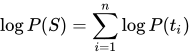
Wordpiece 算法的逻辑基本与 BPE 算法类似,使用最大似然估计(互信息)算法替换了贪心算法。
以下对最大似然估计算法做个简要介绍。
对于文本训练集 S = (t1, t2, … , tn) 由 n 个 subword 组成,对于英文而言初始化的 subword 就是 ASCII 表中的 95 个可显字符。假设各个 subword 是独立存在的,那么训练集 S 的似然值等价于所有 subword 的概率乘积: